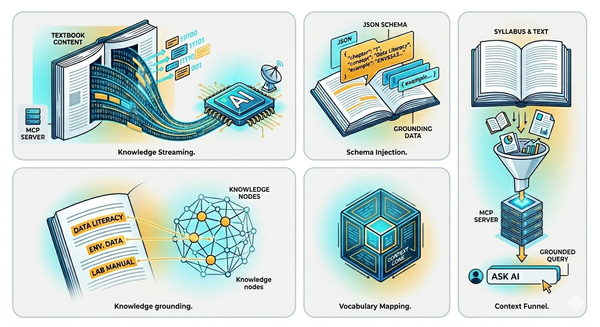
Personal Knowledge Management Your Vault, Your Vectors — Building a Local-First MCP Server for Your PKM Every external AI session starts cold and we spend too much time explaining context and background to our AI Models. Nooscope is a local MCP sidecar that keeps your vault queryable — and writable — from any AI client, entirely on-device.
Artificial Intelligence Escaping Walled Chat Gardens—A Chat History Converter All my AI conversations were trapped inside various bot models, and my PKM had no access to them. Here is a converter that exports your chat history to local files for your knowledge management system.
Teaching BloomSpread: A Course Design Framework for Quantifying Cognitive Scaffolding Bloom Spread is a novel metric that quantifies cognitive complexity in educational design by aggregating Bloom’s taxonomy classifications from individual assessments through learning objectives to course and program outcomes.
Courses Population Genetics Theoretical and empirical analyses of how demographic and evolutionary processes influence neutral and adaptive genetic variation within populations.
Courses Environmental Data Literacy Developing quantitative analysis skills for data visualization, manipulation, analysis, and communication using the R statistical language.
fujifilm Extracting FujiFilm Simulation Data Here is a short write-up on a script I wrote to extract Fujifilm custom recipe data from EXIF metadata and make it accessible to Apple Photos and Adobe Lightroom.
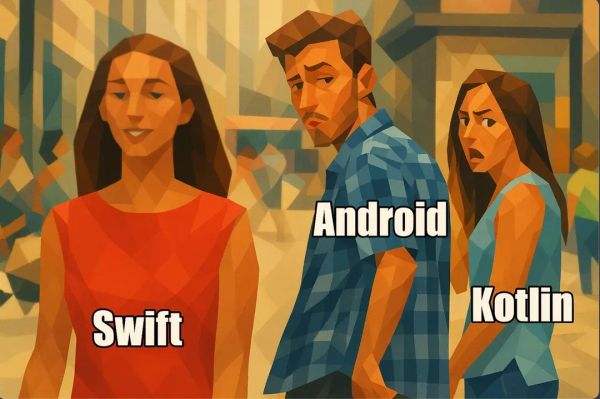
programming Deploying Swift to Android? I was going to write 'Congratulations, Swift.' But more like: Congratulations, Android developers! Today, Android devs can develop in the great language Kotlin, and soon they can develop in the AMAZING language Swift!
Python Upgrading Python on MacOS for Local LLM Training Upgrading your local Python to the latest version on macOS in preparation for LLM training. Also adding the latest build of Apple's MLX framework optimized for Apple Silicon. This is the first in a series of posts on my journey of localized model training for analytics and software support.
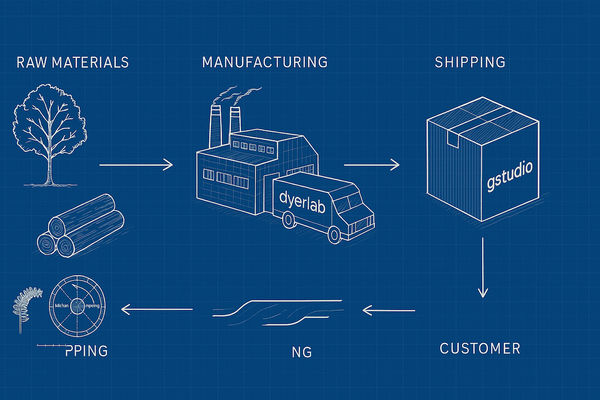
R GStudio Package Update The latest update to the population genetic analysis is the R package gstudio. These updates mainly dealt with workarounds for missing data instead of just returning NA.
Courses Personal Knowledge Management: Building Your AI-Supported Second Brain This course introduces participants to personalized knowledge management systems that enhance the collection, organization, and retrieval of academic and professional information.
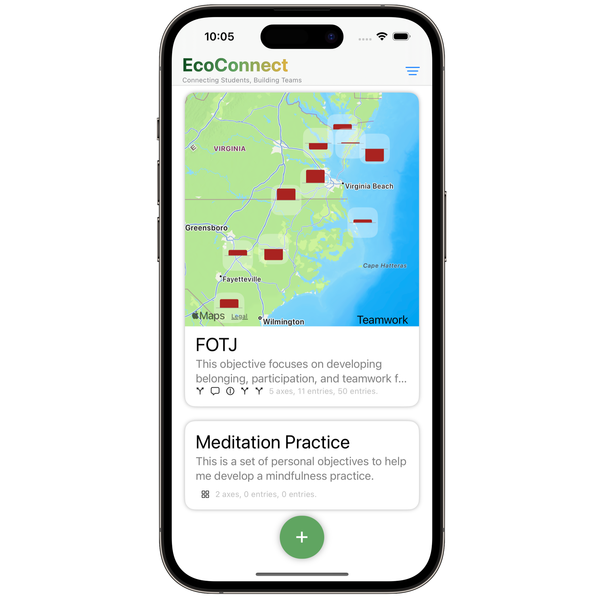
software EcoConnect By combining structured reflection with relevant quantitative data collection, EcoConnect seeks to increase learning and accomplishment in and outside the classroom.
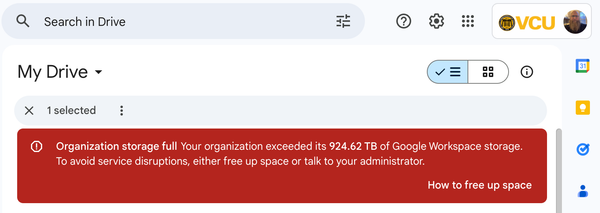
Sometimes, the Universe tells you it is quitting time. It's Friday afternoon; apparently, we've only paid for the 925TB storage option. It's time to go home.
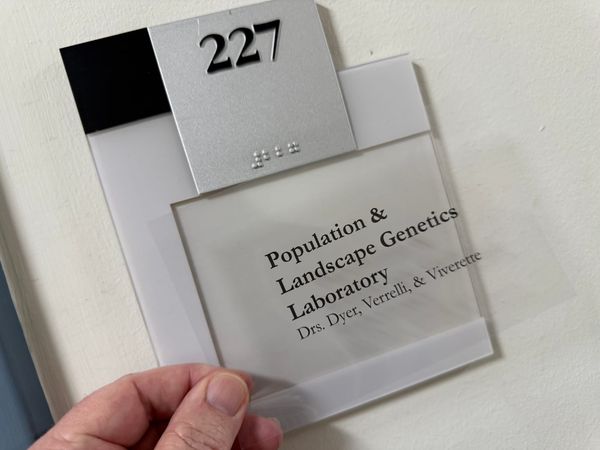
Professional Why I’m Closing My Research Laboratory After 20 years, I've decided that the economics of modern academic life no longer support maintaining a large genetics laboratory. Here are my thoughts on this and perspectives for the next stage of my career.
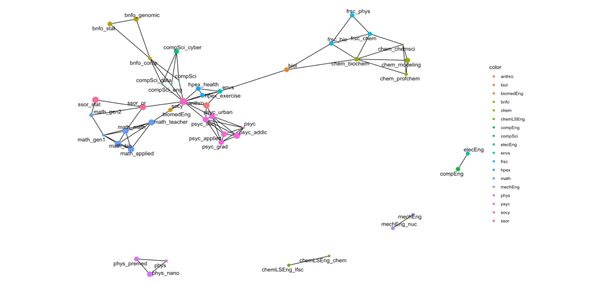
Intentional Curriculum Design The Linguistic Covariance Space of Undergraduate STEM Programs at Virginia Commonwealth University Conditional covariance is a statistical concept that describes the extent to which two variables change together, given the presence of a third variable. Here, I extend this approach to define the covariance structure among STEM curricula at VCU.
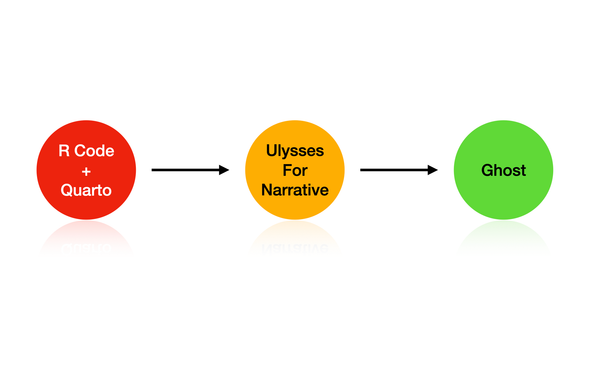
Workflows RStudio to Ulysses to Ghost In much of my work, I use the R statistical programming language and the RStudio IDE to create quantitative aspects of my content. R is a great platform, and the lingua Franca is used for collaborative analyses in biological and ecological studies. It is also an excellent platform for creating
Artificial Intelligence An AI-Derived Podcast of The Environmental Studies Academic Program Review Here is an AI-derived conversational podcast based on the Academic Program Review conducted by the Center for Environmental Studies at Virginia Commonwealth University.
Teaching Personal Knowledge Management: Building Your AI-Supported Second Brain. I am offering a course on building an AI-Supported Second Brain in Spring 2025. Here is the current working syllabus.
Intentional Curriculum Design Frequency-Dependent Linguistic Embedding of Course Descriptions Mapping textual input into quantitative spaces facilitates statistical analyses supporting decision analytics. Here, university course descriptions are mapped onto numerical spaces and used to define the landscape of academic offerings.
Intentional Curriculum Design Linguistic Taxonomies of STEM Programs: Parsing Course Descriptions This post is a data component of the work going into the Intentional Curriculum Design: A Data-Centric Approach for STEM Curricula. This contributes to the section defining The Curricular Landscape, where I define undergraduate STEM programs at VCU and from across the Commonwealth of Virginia, using a quantitative linguistic approach
Intentional Curriculum Design Intentional Curriculum Design: A Data-Centric Approach for STEM Curricula From 2015-2025, I have had the distinct honor and privilege of serving as Director of the Center for Environmental Studies at Virginia Commonwealth University. During this time, the faculty and I conducted a complete revision of the undergraduate and graduate curricula. These changes resulted in: * A marked increasing the quality,
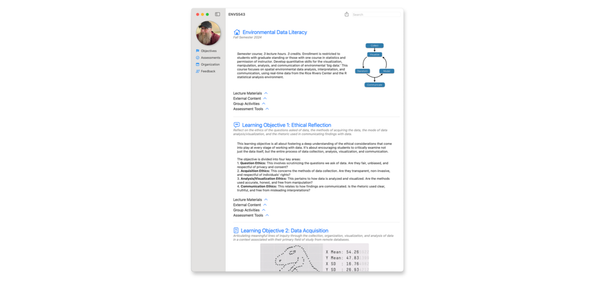
software Backflow.Studio An app to assist in developing course content using Backward Design principles. The audience for this is the instructor/teacher/professor who wishes to incorporate the following into their curriculum development: * Learning Objective focused. * Visual Mapping of Assessments & Assets onto Learning Objectives and Outcomes. * Automatic syllabus creation. Design Philosophy
Intentional Curriculum Design Backwards Design Backward design is an approach to curriculum development that starts with the end in mind. It identifies the desired learning outcomes and then works backward to develop the curriculum, instruction, and assessment methods. 1. Identify Desired Learning Outcomes: The first step in backward design involves clearly defining the knowledge and
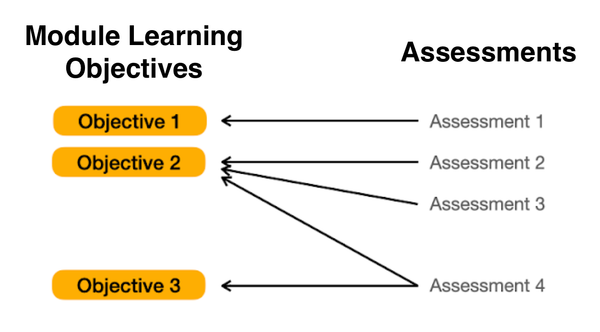
Intentional Curriculum Design A Learning Module Approach to Course Development A compartmentalized approach to course content development that emphasizes backward design and assessment mapping, forming the rationale for the BackflowStudio application.
leadership Characteristics of Successful Academic Leadership Academic leadership requires a unique blend of skills and qualities. Here are some key traits that I associate with leaders who have had transformational impacts on their units, faculty, students, and academic programs.